
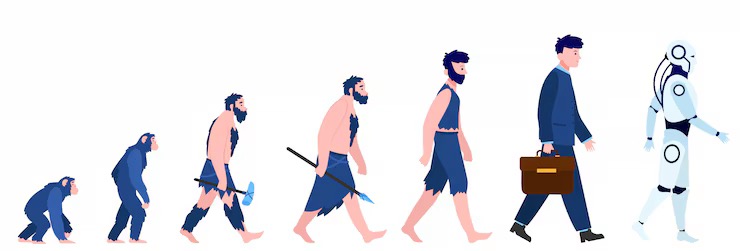
AI: evolution not revolution
Guide to the future of workplace supplies sales – Simon Blackburn, Sales Director.. This article first appeared in the August 2026 edition of Workplace360
You’re bombarded with AI rhetoric: how it’s revolutionising the world and every business in it – adopt it now or get left behind. Is it an expensive buzzword that’s threatening jobs and the personal relationships you’ve built; or is it a means of reducing unnecessary administration, helping you to identify new growth opportunities and allowing you and your team more time for selling? You might guess that this article leans towards the latter. At some point, if it hasn’t happened already, some of your competitors will embrace AI and steal a real market advantage.
Many of you already use LLMs such as ChatGPT, Claude or Gemini for research and writing. But how else does AI help to grow your business? When should you adopt it and are you staring down the barrel of major investment? Upfront: don’t panic. Avoid investing heavily in shiny new technology until you’re ready. Many businesses waste budget introducing AI tools before they are ready. The prudent approach is a ‘crawl, walk, run’ strategy – evolution rather than revolution.
Stage 1: Crawl – fixing the CRM gap
Do you use your CRM effectively? Many dealers have one, but it is underused for data reporting and analytics. Feedback from ERP software vendors supports the view that you must leverage the full power of your CRM before moving to new AI sales tools.
Salespeople are paid to sell, so deal notes are often missing and customer information sits in emails or spreadsheets. Many AI projects fail because of this inconsistent data foundation. These tools only work with the data they’re given; if information going in is incomplete, the results will be too. Fix the CRM gap using these three steps:
-
- Three mandatory fields: Start with the basics: customer name, deal value and next action date. Make them mandatory so a rep cannot move an opportunity forward without completing them, making your pipeline accurate.
-
- Synchronise emails and calendars: Most CRMs offer email syncing so outbound messages and responses automatically attach to the right account. Calendar automation also ensures that tasks are never missed, allowing you to measure prospect ‘touches’.
-
- Create a ‘one source of truth’ rule: Eliminate spreadsheets and notebooks. If a deal isn’t in the CRM, it doesn’t exist. Review pipelines using CRM data only. Ensure that your CRM integrates with your ERP system so that data such as contract pricing, quotes and trading history flows both ways.
None of these steps requires new software. They simply make your existing data trustworthy enough to support reporting, forecasting and eventually AI.
Stage 2: Walk – intent data, contact enrichment, AI content
Once your CRM foundation is in place and your customer data is accurate, you’re ready to transition from the ‘crawl’ to the ‘walk’ phase. This is where AI shifts from an internal administrative tool to an external revenue engine.
Historically, prospecting has been a numbers game: using local business directories, working the phones and door-knocking the industrial estates with physical mailers and wholesaler catalogues, hoping to catch a purchasing manager at the right time. Occasional hit, lots of misses.
In the modern B2B landscape and certainly when using AI revenue technology tools, that scattergun approach is effectively dead. The whole buying process has changed – gatekeepers are harder to get past and the success ratio on cold calling and cold emails is lower than ever. AI changes that through two mechanisms.
1. Intent data
Think of intent data as digital body language at the corporate level. Long before an organisation formally issues an RFP for a multisite workspace fit-out or a single-source workplace supplies contract, its employees are leaving breadcrumbs across the web.
AI tools continuously scan these unstructured web signals to identify abnormal spikes in research behaviour. Instead of chasing every business within a 50-mile radius, a dealer using intent data can see exactly which local accounts are actively demonstrating buying signals.
AI doesn’t change the skills required to win a modern B2B account; it simply automates the process and takes away the hours of research required to get your foot in the door (see below).
The stages of evolution of an AI-empowered dealer sales function
| Stage 1: The traditional approach | Stage 2: The modern approach | Stage 3: The evolved dealership (AI-powered) |
| High manual effort | Reactive | Volume-driven | High intelligence | Relationship-driven | Targeted | Maximum scale | Automated intelligence | Relationship-focused |
| Static local directories (working outdated, cold lists)Blind cold calling (dialling gatekeepers with zero context)‘Shoe leather’ prospecting (walking industrial estates, dropping brochures)Passive referrals (relying purely on word of mouth)Administrative burden (manual notes and spreadsheets) | Digital relationship mapping (who they follow, comments/likes, common misconceptions)Monitoring ‘trigger events’ (corporate change: relocations, expansions; good news: awards, funding)Macroscopic research (sector developments, trade and local press)‘Lookalike’ intelligence (identifying buyers that match profitable accounts)Buying committees (mapping ‘who’s who’ and key decision-makers)The bottleneck: Manual modern research takes a sales rep 4-6 hours per week, reducing face-to-face selling time | All modern research, fully automated and saving hours per week per salespersonAutonomous monitoring (scanning local press, social, registries 24/7)Instant trigger alerts (morning dashboard notification: “Account X is hiring; CEO liked ergonomic post”)Pre-mapped committees (contact details, direct dials and mutual connections enriched directly into CRM)The ultimate ROI: Reclaims 5+ hours per week per rep, shifting focus purely to face-to-face selling |
Most salespeople will be at Stage 2. Imagine what you could achieve at Stage 3 of the evolution (see below).
| Intent signal category | What the AI tracks | What it means for a dealer |
| Content consumption | Multiple users from a local law firm downloading buyer guides for commercial A3 multifunction printers | A high-probability MPS contract opportunity is opening up |
| Operational & hiring | A regional logistics company suddenly posting job openings for branch operations managers | They are expanding physical locations; they will need immediate facility supplies, safety gear and office furniture bundles |
| Technographic shifts | A major local employer coming to the end of supplier contracts as they approach expiration | Their current vendor relationship is vulnerable to an aggressive, service-led intervention |
Instead of guessing which business is ready to buy, intent data tells you who is already halfway to making a decision.
Intent data platform examples:
-
- Bombora: The gold standard for B2B intent data. It tracks when companies are suddenly researching specific topics (eg, managed print infrastructure or office ergonomics).
-
- 6sense and Demandbase: Combine intent data with predictive analytics to tell you exactly which accounts are in a buying window.
2. Contact enrichment
Once you’ve identified a local business that has a high intent to buy, who do you approach? In the workplace supplies sector, this is rarely straightforward – the decision-maker might be a facilities manager, procurement specialist, IT director or operations manager. This is where AI-driven contact enrichment changes the game.
When the intent system flags an active account, enrichment tools instantly cross-reference live professional networks and corporate registries to pinpoint the exact individuals on the buying committee.
AI also continuously cleanses these records. If a purchasing manager at a target client retired last month, the AI automatically updates your prospect list with their successor’s verified direct-dial number and corporate email address.
Warning: Avoid data overload
An untrained sales team hit with an avalanche of third-party data signals will experience analysis paralysis, spend too much time analysing charts and far less time talking to clients. Start small. Your existing data sources or B2B e-commerce platform providers may now offer lightweight, native plug-ins that flag when an existing or lapsed client visits your specific pricing pages or looks at a new product category on your web portal.
Contact data tools examples:
-
- ZoomInfo and Cognism: Main players for accurate corporate contact details and direct dials.
-
- Apollo.io and Lusha: Cost-effective entry points for dealers looking to enrich their CRM data without a massive upfront contract.
3. AI content
Once you know which companies are buying and who your buyers are, the next step in your technology evolution is making contact. AI can write thousands of sales emails in seconds, as well as generate endless social media posts and automatically handle customer enquiries. But, as a dealer that has likely built a business on client relationships, personalisation and high levels of customer service, is this what you or your clients want?
The goal is therefore not to use generative AI to write more emails, but to use AI to write better, highly tailored messages in a fraction of the time.
Moving past the generic
The average B2B purchasing manager receives dozens of identical outbound sales emails a week – you have to stand out. Generative AI allows a sales rep to take an ordinary email and instantly inject real local relevancy. By feeding the AI platform with a few basic points, you’ll get a tailored first draft in ten seconds (see below).
| The old way (time consuming) | AI-assisted way (efficient and relevant) |
| Trying to customise a 300-word proposal cover letter for a local medical practice’s hygiene and janitorial supplies. | Feeding a prompt to the AI: Draft a polite email to a local medical practice showcasing how we transitioned a similar three-site practice to automated facility supply replenishment, saving them 18% on bulk ordering costs. |
| Spending an hour rewriting a legacy managed-print brochure into a fresh LinkedIn post or a PDF case study. | Uploading a raw bulleted list of a customer success story and asking the tool to format it into a professional case study template. |
Upgrading proposals, custom RFPs and the world of bids
AI text tools are great for summarising long-form documentation to enable you to focus on the core salient points. For example, if a local council or school releases a dense, 50-page RFP document, a rep can use an AI tool to instantly extract the key requirements, compliance deadlines and evaluation criteria. This ensures that your team spends their time perfecting the commercial bid rather than hunting through pages of legal jargon.
Warning: Keep the human-in-the-loop rule
Establish an absolute, non-negotiable rule for your sales team: never copy, paste and send AI-generated text without a human edit. Use AI to give you a fast first draft which must be reviewed, with your own voice injected. Add specific local context (eg, mentioning a delivery driver by name or referencing a local landmark) and verify every single product specification.
Personalised content and AI writing tools examples:
-
- HubSpot AI and Salesforce Einstein: If you use these CRMs, then you already have built-in AI writing assistants inside your email windows.
-
- Lavender: An AI sales email coach scoring a rep’s email in real time, telling them whether it sounds too robotic, too long or too aggressive before they send.
-
- Grammarly Go and ChatGPT: Excellent general-purpose assistants for summarising 50-page RFP documents or rewriting rough bullet points into professional proposal cover letters.
Stage 3: Run – analytics and coaching
1. Predictive analytics
If everything else is in place, you’re ready to move to the final stage. This is where dealer principals and sales managers get excited about flashy dashboards and activity monitoring.
However, tracking every move in a salesperson’s day will prove counterproductive. The goal of AI analytics is not surveillance; it is collaborative coaching.
Moving from historic metrics to predictive analytics
The problem with the traditional backwards-looking metrics is that by the time you spot a drop in revenue, it’s already too late to fix it. AI analytics changes this by analysing your pipeline and looking for patterns of deal slippage. Instead of asking a rep, “How is the XYZ account looking?” and getting the normal vague, optimistic response, a CRM backed by lightweight AI analytics looks at the data objectively.
The AI alert
“The XYZ proposal has been in the ‘Review’ stage for 14 days. Historically, if a contract of this size doesn’t have an email interaction every six days, our win rate drops by 60%. Action recommended.”
Predictive pipeline analytics tools examples:
-
- Salesforce Einstein and HubSpot Sales Hub (Premium): Native AI engines scanning active pipelines, assigning a health score to every deal based on real-time activity.
-
- Clari: Eliminates guesswork from sales forecasting, mapping out the reality of a dealer’s pipeline, showing which accounts need a collaborative team intervention to cross the finish line.
2. Conversation intelligence
One of the most transformative elements of the modern sales function is conversational AI. Tools in this category record and transcribe sales calls and video meetings, and even scan email threads (with customer consent) to analyse the actual words being said.
You don’t have time to join the salesperson on every call, so using an AI coaching tool is a great way of helping them to develop their effectiveness:
-
- The talk-to-listen ratio: Is the rep spending 80% of the call pitching products rather than listening to the client’s needs and operational headaches?
-
- Pricing resistance objections: Flag every time that a prospect mentions a competitor’s pricing, allowing you to adapt your business strategy in response to market activity.
-
- The ‘good call’ playbook: When a salesperson wins a major new multisite office fit-out contract, AI isolates exactly what phrases, questions and pacing worked on a successful call so that you can clone that success across the rest of the team.
Warning: Protect your sales culture
Show your salespeople that AI is there to take the guesswork out of their day, telling them exactly which accounts are slipping so that they can focus their energy on closing deals. If they can see that it means fewer useless meetings, less administrative nagging from management and higher sales figures, then there will be little resistance to technology evolution.
Conversational intelligence tools examples:
-
- Gong and Chorus.ai: Plugs into Zoom, Teams and phone systems to analyse sales conversations eg, the time a rep spent talking versus listening or flagging when a competitor’s name or a pricing objection is brought up by the buyer.
-
- Fathom and Otter.ai: AI note-takers that sit in on virtual sales calls and generate instant summaries and actionable next steps so that the rep can focus entirely on the customer instead of scribbling notes.
For traditional workplace supplies and commercial dealers, the relentless daily noise surrounding AI can feel more overwhelming than empowering. This article offers something more practical: a grounded, risk-averse roadmap tailored specifically for dealers that want to protect their local contracts without disrupting their businesses. The aim is to promote the transition from static, manual sales methods to an automated, high-intelligence model.
Ultimately, AI doesn’t replace the vital human relationships that dealers rely on – it simply automates the hours of digital grunt work, giving reps more time to sell face to face.
Simon Blackburn has spent years in the trenches of sales and business leadership, most recently scaling a successful SaaS business in Learning Technologies. Simon has a real passion for helping SMEs on their evolution and growth.
Sinon knows first-hand that the journey to growth is rarely linear, and that making bold decisions means you won’t always get it right. It’s those hard-won lessons that form the foundation of how he helps other high-growth companies.
Simon partners with business and sales leaders in different B2B vertical markets to tackle their most pressing commercial challenges. Whether you need to refine your overall sales strategy, create and implement a bulletproof sales process, build and develop your sales team or simply mentor your sales leader to a new level of success, he provides the hands-on expertise needed.